100,000 users in 6 months.
That was the growth marketing goal Mint.com’s co-founder, Aaron Patzer, set me when I first started as Mint’s Marketing Director. I thought to myself as the nerves began to kick in. “How am I going to achieve that?”
Fast forward 6 months and Mint had over 1 million users – 10x the target Aaron set me on my first day.
Want the one email I send when I have something worth sending?
114,000+ entrepreneurs get it. One story from my business, one tactic you can use. No schedule, no fluff.
So how did that happen?
There are 2 key reasons for Mint’s success:
First, the product was awesome. Having a great product makes marketing less about “selling” and more about educating your target audience and spreading the word. Still, no matter how great your product is, if no-one knows it exists, no-one will use it.
The secret to marketing is…. Build a great product.
— noah kagan (@noahkagan) January 9, 2017
Second, before Mint launched I knew we needed a growth marketing strategy. So instead of opening up Google and doing ‘social media marketing’ or ‘growth hacking,’ I created a framework to reverse engineer our growth from zero to 100,000 users.
And that exact framework is what I’d love to share with you today. Here’s the strategy I used to grow Mint.com from zero to 1m users…It was subsequently bought for $170 million dollars by Intuit. #payday
| Get the same spreadsheet I used to grow Mint |
Quant-based marketing: Reverse engineering growth marketing success
No matter what your goal, whether it’s 10 new consulting clients, 10,000 people on your mailing list or 100,000 sign up so your new app, quant-based marketing can help.
The key focal point to this strategy is to work backwards. Instead of starting with an intimidating zero playing on your mind, start at the solution and map your plan back from there.
Think of it as a road trip – you start with a set destination in mind and then plan your route there. You don’t get in your car and start driving without in the hope that you magically end up where you wanted to be.
So where should you begin?
Getting started with quant based marketing in 7 simple steps
Step 1: Setup your goal
Having a goal to aim for is the most important part of any marketing strategy.
Way before you start thinking about specific tactics or growth experiments you need to have a tangible and measurable goal set in stone.
There are various ways to come up with great goals, but with the quant-based marketing approach, I’d recommend working backward from your overall company goal or the amount of revenue you’re targeting.
For example, let’s say you’re selling a product at $100 per month and want to increase your monthly revenue from $0 to $10,000. The first thing you need to do is work out how many customers you need to hit the sweet spot of $10,000 per month. In this case, it’d be 100 customers paying $100 a month.
Step 2: Choose a timeframe
Without a time frame, there’s no sense of urgency to achieve it, and it can be hard to work out whether you’re on track or lagging behind where you should be. Saying ‘we need $10,000 per month someday’ won’t work. But if you anchor it within a timeframe, like ‘in 3 months’, then you’re instantly set in motion and ready to start working towards your goal.
100 new customers in 3 months. Now that sounds like a real goal, right? You could even break it down further to ~16 new customers per week.
Once you have your goal set, the next step is to start formulating your plan.
Step 3: Set up your spreadsheet
Now that you have a clear goal in mind you can start to building a strategy on how to achieve it.
The best way to do this is by using a quant-based marketing spreadsheet to plan, track and measure all of your marketing activity.
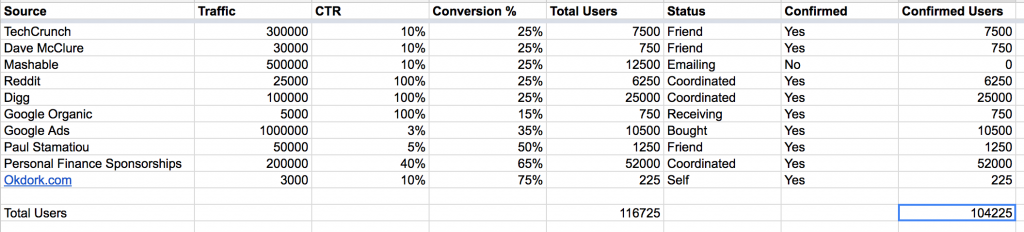
Here’s an example spreadsheet I used at Mint:
| BONUS: Get the spreadsheet |
The spreadsheet is broken down into eight columns. Here’s how to use each column:
- Source: Where are these users coming from? This source could be a blog you’re aiming for coverage on, Facebook Ads, Google AdWords (now Google Ads), or any marketing channel
- Traffic: How much traffic does this channel receive? Or for an ad on Facebook or Google Ads, how many impressions will you make? Use your BEST GUESS. The point here is to help you prioritize the different marketing channels
- CTR (Click-through rate): How much of that traffic will click through from the source to your website?
- Conversion %: Of those who click-through to your site, what percentage of those will convert to sign-ups?
- Users: How many users will this channel bring you? These are people who complete your signup process and use your product (this is your best estimate based on the numbers in the previous columns)
- Status: Where are you with this source? Is it all ready to go? Have you sent the first inquiry about the setup? Keep track of the status of each source in this column
- Confirmed: Is this happening? Yes or No
- Confirmed users: How many users did this source bring you? Confirmed users is the most critical column in the sheet. This number shows you how many users you generated from this source. Then you can re-prioritize your marketing efforts moving forward based on the results
The most important part here is putting the framework in place to enable your success.
Step 4: Research your sources
With your spreadsheet ready to rock, it’s time to start thinking about your sources and where your users are going to come from.
There are thousands of tactics and channels you can use as a part of your marketing strategy, and this step is all about narrowing them down and choosing a number of specific sources to focus on in order to achieve your goal.
From my example spreadsheet, you can see I targeted 10 very specific sources to drive traffic to Mint.com and contribute to the goal of acquiring 100,000 users in 6 months:
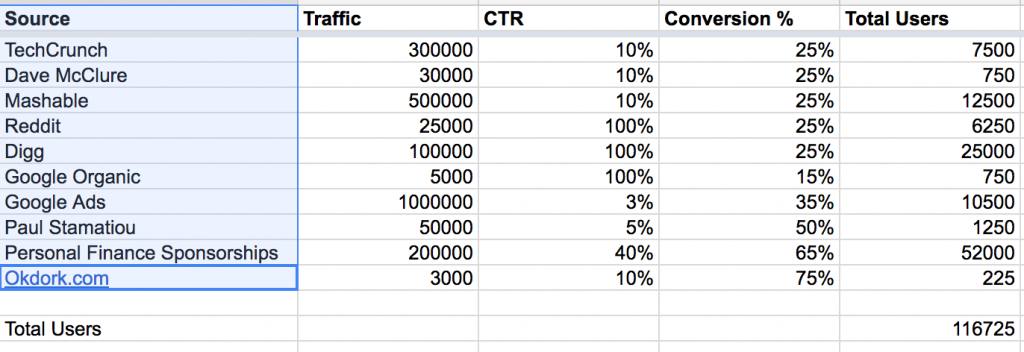
As Mint was focused on personal finance, I wanted to target personal finance bloggers and tech professionals.
Who’s your target customer?
Here’s a bunch of channels you could use:
- PR: Pitching the press and bloggers in your niche to cover your story
- SEM (Search engine marketing): Paid ads on search engines like Bing and Google, so your name will appear when certain keywords are searched
- SEO (Search engine optimization): Optimizing your blog posts, landing pages and site to rank well in search engines for keywords related to your business
- Social and display ads: Targeting your audience through ads on social channels like Twitter and Facebook
- Content marketing: Creating and publishing content (blogs, podcast, video) with the goal of generating interest in your product/service
- Direct sales: Directly speaking to potential customers. This could mean picking up the phone and calling potential customers or sending cold emails to prospects
- Target market blogs: Sponsor posts and content on popular blogs within your target market
- Influencer marketing: Identify and build relationships with individuals who have influence over your target market (e.g. high profile bloggers or Instagrammers)
1. This helps you prioritize
2. List at least 10, ideally 15
3. Point is to just think about WHERE those ideal customers are.
To prioritize which sources to run within your quant-based marketing strategy, I’d recommend using a simple scoring system based on:
- Ease of implementation
- Potential impact
With this system, you’re looking for the sources that could have the highest impact with the easiest implementation. For example, getting featured in the NY Times could have an incredible impact, but extremely hard to implement, whereas working with a couple of influencers in your niche could be highly impactful and straightforward to implement.
Take each channel and give it a score out of 5 for both ease of implementation (1 being hard, 5 being easy) and potential impact (1 being low and 5 being high) and then prioritize the sources with the highest scores. For example:
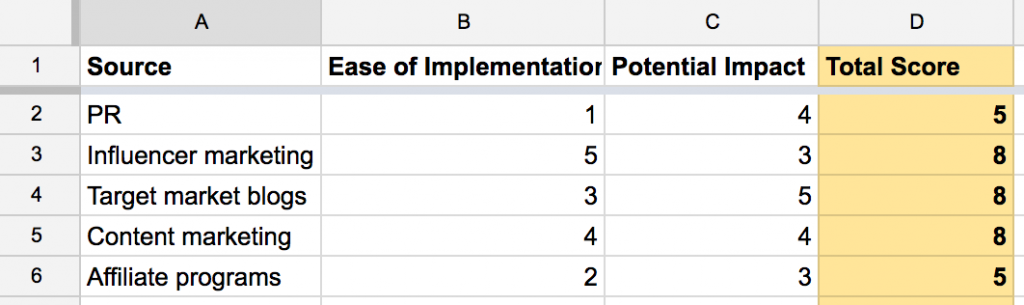
Now your high priority sources should be clear, and you can ensure you focus your time on only the maximum impact opportunities. So from the spreadsheet above I can see I should be focusing on influencer marketing, target market blogs and content marketing.
Consider your budget and timeframe
When thinking about the ease of implementation and the potential impact a source may have, it’s important for you to consider your timeframe and budget.
Timeframe:
Let’s say you’re starting at zero and trying to acquire 100 new customers in a month. Would it make sense to create a fully-fledged SEO strategy?
Probably not.
Since you only have a month, it doesn’t make sense to focus on SEO as a successful SEO strategy would take a long time to implement and reap rewards from.
In contrast, with a one-month timeframe, it might make more sense to take a more direct approach to customer acquisition like emailing close contacts or picking up the phone and calling companies who may be interested in what you’re selling.
Budget:
At Mint we paid for about 40% of the traffic, we generated to grow from zero to 1 million users. When you pick your sources, keep your budget in mind and factor in costs to deciding which sources to prioritize.
If you have some budget, sources like paid sponsorships and social ads can work amazingly. With a small budget or zero budget, it could be better to focus on more organic channels like content and PR.
Step 5: Set your targets
With your sources all in place, it’s now time to set your targets for each source.
Setting your targets is hands down one of the most important parts of your strategy. Once you’ve launched your campaign for each source, these targets will give you something to measure against and figure out what’s working, what’s not and where you need to adjust.
So, how do you go about setting targets for your sources?
When it comes to traffic, you can often find benchmarks by using tools like SimilarWeb or SEMRush. For example, here’s a SimilarWeb traffic estimate for TechCrunch:

CTR and Conversion % are a little harder to gauge. Not all publications will share CTR’s and Conversion %’s for previous advertisers publicly. The point is not about CTR / Conversion but what OUTCOME you expect to get from the source., so you may have to search for some case studies and read up about other’s experiences with each publication you’re targeting.
There are far more benchmarks out there for advertising platforms like Facebook and Google Google Ads. For example, WordStream found that the average click-through rate on Google Ads paid search ads is about 2%. So if Google Ads is part of your strategy, you’ll likely want to aim for around 2% CTR.
When setting your targets, the trick is to use your BEST GUESS; it doesn’t have to be an exact science. It’s all to help you PRIORITIZE your marketing activities.
Step 6: Create a timeline
Now you have all of your sources and targets set; the next step is to break down these targets into smaller, time-focused goals and create a timeline.
Recently I’ve been through this process to set targets for my podcast, Noah Kagan Presents. My goal is to have 100,000 downloads per episode by December. To achieve that, I’ve broken down my goal over 12 months from January to December 2017:
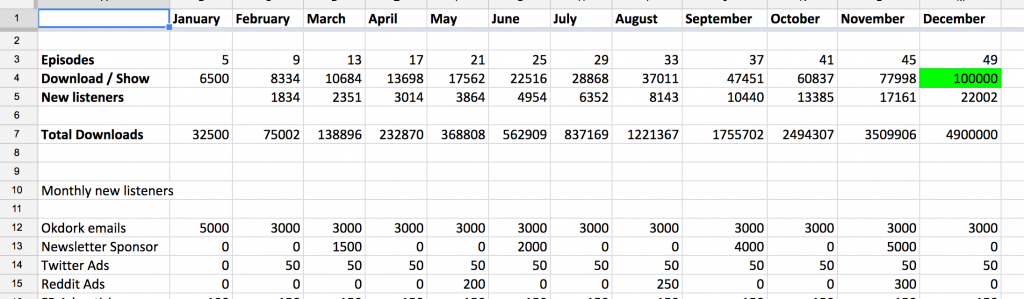
No matter what time frame you’re working with, break it down into smaller, more achievable chunks. If your timeframe is three months, set monthly targets. If it’s three weeks, break it down into weekly targets.
Why should you do this?
Well, aside from making your goals feel more achievable, it’s also highly motivating to tick off the smaller goals on route to achieving your overall target.
With each of your sources, take your overall targets and break them down into more manageable chunks that fit within your timeframe.
For instance, you could breakdown a goal of 1,000 new users from Facebook Ads as follows:
- Week 1: 50 users
- Week 2: 200 users
- Week 3: 250 users
- Week 4: 500 users
With this approach, you’re not heading into week 1 thinking “I have to get 1,000 users.” You’re setting yourself a smaller goal and creating time to experiment and learn what works. After the first week, you can begin to make tweaks and start scaling as you progress and get more familiar with how to drive the best results from each source.
So apply the quant-based marketing framework to each source by working backward from your primary goal, and breaking it down into smaller weekly or monthly growth targets.
Tip: Don’t leave it to chance
Only confirmed traffic sources matter when it comes to quant-based marketing. If you want to be successful, you need to have everything set up and ready to go ahead of time. Don’t leave it up to chance and hope everything falls into place.
Get every source confirmed well before you plan on going live.
For example, if you’re sponsoring a post on a target market blog, ensure they have all the needed content resources and everything is signed off and ready to go well before it’s needed.
Bonus tip: If you are working with partners, give them a calendar invite and the scripts you want them to send. The easier you make it for them, the more likely they are to do it.
Step 7: Track your progress
You’ve now reverse engineered your marketing strategy and should be all set to get the ball rolling. But like any form of great marketing, this isn’t something you can set and forget.
You need to always be measuring and iterating to achieve your goals.
Once you go live, some sources might work right off the bat, especially those you are a little more experienced with. But you definitely won’t hit a home run with every source you try, and that’s perfectly fine. I like to check back against my assumptions monthly. From there I take the ones performing and see if I can 2x them, the ones underperforming I’ll generally kill, immediately.
The most important thing to ensure you’re on track to hit your end goal.
The first couple of weeks of your strategy will likely feature a lot of experimentation and testing until you find what works (and what doesn’t).
At Mint, we tested some landing pages (6 in total) when we first started marketing the product. The data from these tests enabled us to learn more about which messaging resonated most with our target audience and helped us to refine our copy and increase our conversions.
This is why it’s key to measure your results in a spreadsheet so that you can spot where you need to adjust your plan.
If a source is underperforming, and you’ve tried multiple tests to get to the bottom of why that is, you can drop it and replace it with another source.
Likewise, if a source begins to perform exceedingly well, you should double down your resources there in order to maximize your growth.
If you enjoyed this post, check out some more OkDork guides:
Start a business in 48 hours.
Million Dollar Weekend is the process I used for eight businesses, written down. #1 on Amazon and Audible.
Read the first chapter free
113 responses to “Growth Marketing Mint.com From Zero To 1 Million Users”
Good read, and very practical. Thank you.
Great information , very helpful thank you !!!
The article read was well understood.
Great analysis. In particular, the non-paid-for traffic and conversions are the most interesting and way more difficult. I’d love to learn how you scaled this email newsletter in free, organic non-paid for ways…
thank you.
Loved this article which was very specific and practical. Would love to connect with you and show you how we are building a better product than mint
Really enjoyed reading this piece and it’s certainly something I will use in my area of work. Thank you
Great information !! thanks very much!
This was so informative, thank you! I am new to this and was feeling very daunted by how I would get the growth targets I am setting for my app. This has provided the detail I needed to make my plan actionable. Feeling lighter so thank you.
Whheeeww, this was a whole lot of valuable info, thanks Noah. I’m starting out as a freelancer and i think this approach would work for me.
Those CTR and conversion rates are impressive! Any chance you’d share some of the ads and landing pages you used?
Thanks for the education. Subscribed to the podcast now. Hear you soon. 😉
Nicely, and logically, laid out. The idea of apply quant-based marketing to non-marketing processes intrigues me, as well.
I love Digital Marketing, so when I have started my job, I usually try to find out everything about it. Fortunately, I saw your article, it’s very good. I think that I can feel more confident and do my tasks easily.
Very good, Noah. A simple and sensible planning that leaves our marketing goal almost unpretentious.
This is excellent. Thanks Noah
quant-based marketing approach is practical. Great article and thank you for sharing
I think you’re a damn genius. Hi there. This is Kamber. Your neighborhood blacksmith. (Who is learning SEO and Copywriting at the moment).
Thanks for this eye-opener. As I was reading this, so many things were just running through my mind on how this could boost up my Agency.
I would like to download the sheet please. I see the yellow mark, but not hyperlinked (even in incognito).
Help?
Hi Milos, it works for me! Try again, sometimes it takes a moment for the link to load. Or, I recommend a different browser and making sure your ad block/Do Not Track is disabled.
Is there any chance the spreadsheet is still available?
Yup. 🙂 It’s still available. Just click the green “Get the same spreadsheet I used to grow Mint” hyperlink text on the gold background part.
If you don’t see that text as hyperlink, try opening Incognito. Some aggressive ad blocks may block it.
Hi,
I am the CEO and co-founder of my startup Pollesta. We have just recently formed a company and there are currently 4 full time members of the team working hard on our fresh and cool new ‘surveying tools’. We are aiming to completely change the way surveys are done by trying to make them more attractive, fun and entertaining.
What we are looking for is an amazing and enthusiastic growth hacker to join our team for an equity stake in the company! Someone really passionate and driven by hard work and determination! If this is you, or you know anyone please reply to this comment and I would be keen to discuss things with you!
Thanks
I found you completely organic Noah Kagan when I started to do a 5 AM challenge. Found your blog, podcast and so on..Love your stories with FB, Mint..
wow..thats great work.just Working on my first startup~mobile application. I now have an idea of How to go about it..thanks
Can you elaborate on how to estimate your targets? Especially for something other than websites – like building local relationships for a local service business. I feel like I’m just pulling numbers out of my ass.
This is so important for me! I want to start a social network called Worldlie, and I KNOW that it couldn’t grow organically. How exactly are you advertising on the tech websites? Is that Google AdSense? I am unclear about ads except for Google AdSense, and TBH, I’ve never created a regular Facebook ad. I also read, I think on your blog, to not ever to boost posts, since it doesn’t give website clicks.
I also didn’t get the best news about sponsoring content format, so now that will have to be re-done (regarding my site). I really need to look into this further. How much did you spend, though?
Such a valuable article! I am always a fan of Okdork and I have read most posts of it in order to apply tactics for my website. Talking about setting up the framework, I downloaded the spreadsheet but I still have no clear ideas to make it for own.
I wonder if you could make a practical test marketing framework which makes it easy to customize.
Thanks. Always your fan 🙂
You can grow a company from 0 – 1M, but can you grow a company from 5M – 20M ?
I guess you read the answer before posting. That was the mint.com subscriber number: 20m
I try to re-read this post multiple times a year. It has changed changed how I approach marketing. Much appreciated Noah. Podcast rocks too!
Thanks a lot it has helped… Is it possible to advertise a brand that’s not yet available yet in the market?
“First, the product was awesome.” – The most important statement here.
There are so many guides and success stories out there. But of course it all works when the product is awesome. Techcrunch & co love to publish it, especially when you have friends there. Conversion will be high.
The problem is, before you start you have no idea if you’re product is awesome. You believe it is. You’ll figure out later when these guides don’t work. Which raises the question whether marketing success stories like these aren’t just more than self-fulfilling prophesy…
Hi Noah!
Thank you for sharing 🙂
The conversion rates are pretty high?
Or do you include also Remarketing in youre calculation?
Have a nice day!
Thanks for continuing to update this post. The strategy and action items provide a great framework for a product launch/growth plan.
Very helpful and inspirational. Thank you!
Hello Noah,
I’m so much impressed with tips specially your 0 to 10,000 visitor: Noah edition. I already taken some notes and ready to get my first 10,000 visitor within 60 days. Notify you what happen next.
From the article, I noticed you talked about influencer marketing but I’ve zero connection with them Is there any tips or resources you point me ?
Thanks!
Pradip Singha.
Awesome content Noah! Thanks for sharing it with the startup community 😉
I like it…
Thanks for updating this post. It is more refreshing to read and the additional insights are quite helpful. Am currently working on growing a SaaS in the online invoicing space (www.ProbityBooks.com) and this will be super helpful.
How can I send some Tacos to say thanks ?
Check out my about page =)
Hey Noah, what’s the name of the app you’re using to gate the spreadsheet? Is it part of the Sumo Pro pack or List Builder 3? Thanks!
It’s using Click Triggers within List Builder 3.
Thanks, Noah, for taking the time to write this.
I literally read this over and over again (at least 10 times). 99% of marketing articles I read online tell you “what you should do” but never tell you “how to do it.”
The key thing here is setting up the spreadsheet and tracking your numbers. This is the unsexy part of marketing and most would just prefer to run Facebook ads. But this is absolutely crucial in tracking results and showing other stakeholders how you’re progressing.
Please promise that you will keep your content free!
Such great work, Noah!
I’m a huge fan Noah. I follow your blog and podcast and webinars and use many of your products. But I disagree with you that this post is super-actionable. As you started with, it’s all about having a good product. Well, there aren’t any Mint.com-valuable businesses for sale cheap, easy to build oneself, or Mint.coms hiring us to become early-stage marketers like Aaron hired you.
Easy to get $10k/mo in revenue in a growing field, but understand Mint.com and 1 other business were doing this at that perfect time where no finance aggregators existed, and the market was up for grabs. The other business (I can’t even remember the name) had better quality in many respects, and most die-hard finance nerds preferred the competitor, but Mint.com had more aggressive marketing, grew faster, and then later was able to catch up in quality through harvesting the work of the sheer number of users tagging their own transactions in Mint.
What action do I take to get to $10k/mo in revenue without a perfectly-timed-for-aggressive-growth software business/product like Mint or Uber? I spoke with Aaron Patzer (post-Intuit acquisition), and he was only looking to hire excellent freshly-graduated entry-level programmers for weak-ass pay.
It’s kind of no-duh that to get X $/mo in Y months, you gotta set and revise weekly targets. What’s actually difficult and far more important is getting from 0 to 1, how do I get my first $100 value client into a SaaS contract? Where do I get a list of valuable SaaS ideas that need to be implemented, and can be programmed by small teams of 1, 2, or 3 people, or the product development could easily be outsourced for a couple grand, so I can just focus on the marketing? If I had some product or service with a $100 customer LTV in an unsaturated market, I’d have no problem gunning for customers through all the marketing channels available, but the real problem most people face isn’t growing a service fast in an unsaturated market, it’s finding ideas for products and services that will be valuable in relatively unsaturated markets. Ideas have to be valuable, and in relatively unsaturated markets. For example, web-hosting or solar panel installation are quite valuable customer LTVs, but they’re competitive and highly-saturated markets, so even if I took actions in this post, I don’t think there’s a strong likelihood of growing a $10k/mo web hosting service from scratch. Even if it’s a good hosting product, there are thousands of other marketers saturating the channels, and acquiring every marginal profitable customer.
For example, I have no idea what action to take after reading this post. I’m not sure if your blog readers are all marketing executives and growth hackers at lucky startups in unsaturated markets, but I doubt many of them will be able to apply this and take action, either.
I agree and would love to have seen an answer to your questions. Best of luck on your venture.
Tom, I think Noah’s post is *very* actionable… IF all of the issues you brought up in your comment are handled.
The problem for most founders and marketers is that they don’t realize this when they plunge headlong into starting up a company. At least you are conscious of the problem… which will save you a lot of time, money, and heartache.
Succeeding in building a winning business is pretty straightforward: when the dust has settled, you need to be the dominant supplier to a market. As far as I can tell, there’s 2 ways to do that: 1) have a great idea, be first, and work like hell to stay first; or 2) see an attractive market that some tech-focused team thought up first, and take it from them by force (with greater money, resources, connections, and most of all, better marketing).
It’s true that SaaS used to be more of a green field, and it’s crowded and competitive now. No point in lamenting that, it is what it is. But if you don’t have the bigger hammer in option 2 above, then as I see it, you need to find a place that someone else hasn’t thought of, and work like hell to keep it. And there’s certainly no list out there that’s going to hand you the answers to that. You have to have enough knowledge of a domain that you can say with confidence, “I know this space cold, I have a better idea for how it can be done, I can get out there first, and with the additional knowledge I quickly amass, nobody is gonna catch me.” imho, if you can’t say those things, you might want to save your money and effort for now, and go to work in a domain that you love until such an idea strikes you… because even if you *can* honestly say those things I mentioned, odds are that you still won’t make it! Good luck to you.
This a great post on starting with the right mindset. This process reminds me of Covey’s “Begin with the end in mind.” Great stuff!
Good article and a very tactical approach. I’ve been reading the book Traction and the approach and framework mirrors yours. They have a chapter dedicated to each marketing approach but yours was much more tactical.
Hey Noah, when I got your e-mail and saw the publication date of the post (february 2017) I thought I was going to read a pretty recent article. After reading it though I saw the first comment was posted way back in 2010, which immediatly made me question the fact if what I just read was still relevant or not. 7 years is a long, long time in this market. Not only that, but you link to a resource (Compete) which is no longer in business.
I completely get the “republishing of old posts to generate traffic” thing. But you should probably be more upfront about it at the beginning of the article and check the tools you mentioned to see if they’re still working.
It’s a nice article though, and still relevant, I just don’t like to feel duped 🙂
Cheers and have a nice day,
Don’t really think it’s dupage…
The first time I wrote this article only 2000 people got emailed. So most people never saw and frankly the original article sucked.
This update is nearly 100% changed and WAY more actionable + clear.
Hey Noah,
While I believe that you weren’t trying to dupe anyone – I think Wouter makes a point. I didn’t know the article was updated (I had read but don’t recall the details of the original article) and seeing the first comment made me suspicious at first too. I wasn’t going to comment until I saw this, cause it’s not that big of a deal. But it made me wonder how many people might see the gap in date, think they’re being duped and leave annoyed without saying anything.
I don’t think it could hurt to make a comment about how this is a brand new revision of an older post now that you’re 7 years smarter and a more badass writer.
Content is still solid – cheers! Keep it up 🙂
Glad people read the whole article 🙂
Yea, will add the article was updated.
This article is as swole as Noah.
Spot on as always. Love the actionable tips.
You’re rad!
Your approach is very similar to the Bullseye framework described in the book “Traction: How Any Startup Can Achieve Explosive Customer Growth” by Gabriel Weinberg and Justin Mares. Did you get inspired from it… or is it the other way around? 🙂
You realize I’m in that book 🙂
Oops, you’re right, i totally spaced out on that!
Very insightful post Noah. I will implement this strategy for my next venture.
Dude, this post makes my head spin, but it’s pretty awesome. Sharing with a bunch of marketing friends. Thanks, Noah!!
Well structured and made a lot of sense! Setting that timeframe really does help create the needed impetus, especially if the work is creative or you’re in an okay position.
@Noah, you should throw a SXSW party for your fans / sumolings. Offer a tour of your office or something. It KILLS me that I’ll be in Austin and won’t get to see you guys in-person. I can only handle long distance relationships for so long, you know.
We are. Tweet me and maybe you’ll get an invite =)
I wonder how many specialists were on the team.
Thanks, Noah. Love the idea of working backward, creating goals and a plan, based on the targets you need to hit within a specific timeframe. I have implemented this strategy for a new project of mine I started four weeks ago. So far, I see steady progress and monthly goals are all on target.
One other thing, I starting listening to your podcast last week and I love the show. Love it so much that honestly, I wish the episodes were longer 🙂
Keep up the great work.
This is brill Noah besides that, I just like the fact that you made it seem easy, but implementation can sometimes be the difference as there are always lots of moving parts
Also noticed you repurpose the content from 2010 very well played still current in this market
Good post . I am trying to figure out how I can use this approach in my job search .