The short version: Tyson Cole was an $18 an hour grocery store manager who talked his way into washing dishes at a Japanese restaurant. When he opened Uchi, sales grew every single month for the first five years, 60 straight months, and it is now six or seven restaurants with about 500 staff. His whole system is one rule: buy the best product every day, even when it’s expensive, and feed it to your staff before your guests.
Updated September 2026. Originally published May 2018.
Uchi’s sales went up every month for its first five years. Sixty straight months.
Tyson Cole is the chef behind Uchi and Uchiko, my favorite restaurant in Austin. He has competed on Iron Chef and won the James Beard Award for the Southwest, and he runs the most popular Japanese restaurant in the city as a white guy from Florida. Around 75% of restaurants fail. I wanted to know what he did that they didn’t.
Want the one email I send when I have something worth sending?
114,000+ entrepreneurs get it. One story from my business, one tactic you can use. No schedule, no fluff.
The answer is annoyingly simple. He bought the best fish.
The door with the samurai on it
Tyson was managing a grocery store on South Lamar for $18 an hour. The store got bought out and the new owners offered him a cashier job at $8.50. He quit. Almost two months without work, and his girlfriend told him find a job or we’re done, we have no place to live.
He went downtown thinking he could bartend at the Elephant Room, the jazz club in the basement. He yanked the door. Closed.
“Went back up the stairs to ground level and then, probably the most important point of my entire life, I looked up the stairs and there was a door with a samurai on it. And I was like, should I go up those stairs and see what’s up there or not? Luckily I did.”
Upstairs was Kyoto. Two women in kimono said irasshaimase. He asked if they were hiring. No. “Please, how about just lunchtime?” One of them, Riko, went back to the kitchen, came out 10 minutes later and said can you start tomorrow. He washed dishes.
He had never eaten food like that. He slept at the restaurant between lunch and dinner, became best friends with the sushi chef, and watched him work the knives until it got to be too much. “That’s such a freaking cool job.” He asked if he could make sushi. “They’re like, no way, you’re white.” So he started in the back of the kitchen where nobody could see him.
Feed the staff the good stuff
Before Uchi, every kitchen he worked in ran the same way. You were an employee, you clocked in, you clocked out. He wanted people to fall in love with the food the way he had at Kyoto.
“When we opened Uchi, I was pretty adamant that I wanted to be the best. I wanted to have the best restaurant anywhere. Why wouldn’t you think like that? So I tried to get the best product and the best people and create the best systems. The fuel for that was all based on the food and the people.”
So from day one he fed everybody, every day, the best product. Not staff meal, and not the leftovers about to go bad. He ordered food for the staff the same way he ordered it for the guests, and he wanted the best product coming in the back door every morning so the staff would wake up excited to go to work and see something they had never seen. Danny Meyer calls the same idea enlightened hospitality: take care of your staff as much or more than your guests.
The hard part was getting the fish. In the beginning the only purveyors who would sell to him were the ones he knew from Musashino, and he was calling them all the time. His analogy is a high-end drug dealer. If you sell the most, you get the biggest shipments.
“I couldn’t find this fish at all. But then once we started selling a lot, my phone started ringing. Every day we’re getting calls from Japan, from the East Coast, from the West Coast. And we said yes, yes, yes, because we were busier every day. So first five years, sales increased monthly. 60 straight months.”
He was doing all of it himself. He sold his car, bought a $1,500 Chevy Suburban, and used the difference for his wife’s wedding ring. Every morning he drove to all three Asian markets and Central Market. Three days a week he picked up the fish at the airport. “I was just determined to find the best stuff every day. That was my goal. I could not have done that today.”
Why don’t other restaurants do this? Because it’s expensive. Sushi is what let him afford it. You sell it by the piece, $8 to $12, two or three or four pieces at a time, and the margins let the kitchen buy product a regular kitchen can’t. He and his partner Daryl, a customer who had watched him go from dishwasher to lead chef, never got into it for the money. “Lo and behold, sushi is probably the best restaurant model ever.”
The rest of the cooking is easy once the product is right. “Food is simple. If you get the best product, you don’t have to do much to it. You really don’t.” Incredible live crab from Alaska, some lemon, done.
He still got plenty wrong. He didn’t want a walk-in cooler because he thought food died in there, and had to build one once they got busy. He didn’t want valet because he thought it was pretentious. “I was stupid. Valet is great. People love it.” His rule for anyone opening a restaurant is 18 months of working capital, because people come in with the food idea and blow the budget on food or labor and then it’s we’re out of money, what do we do now.
Autonomy inside the Uchi box
Most of the food at Tyson’s restaurants is now made by the staff. The menu is half a core menu that never changes and half a specials sheet that changes every day, and the specials sheet is where line cooks become chefs. That is how Paul Qui and Philip Speer came up. They worked with him every day for the first seven years. “I was more like a producer or a director and they were the actors.”
A lot of founders say their team has autonomy and then micromanage them. I asked how he keeps the standard when he isn’t the one buying the fish anymore.
“It’s not absolute autonomy. There has to be some parameters. A good example is they used to make a list, this month here are the 10 things we’re not going to have, so don’t order those, because they don’t fit Uchi. And the more I did that, this box started to form and everybody knew what fit inside that Uchi box.”
Kaz Edwards has been with him 14 years and is now the concept chef. When someone brings a special to taste he’ll go “no, no, no, that’s not Uchi” immediately. “People have autonomy, but only in that box. Without parameters you can’t succeed. If I said, just go write a song, creativity is too hard. It’s too wide open.”
It isn’t always pleasant. “It’s almost like a marriage. There’s a lot of fights.” His rule is side by side, not standing above you. If he was wrong, they called him out, and vice versa. Sometimes they said no, that’s terrible, and he backed off. Sometimes he knew it mattered and wouldn’t bow down. “I don’t care. Make it happen.” That is most of what attracting the best people comes down to, in a kitchen or at AppSumo. They have to know you’re on the same playing field.
Two years into Uchi the first real review came out. Two out of five stars, hard on the kitchen food. “I was pissed. But the reviewer that wrote it was right. The three or four things he called out, he was right. The next day I went in and tried those things. They were terrible.” So he worked on the kitchen more. The people who know the most should review you.
Uchi means home. There are about 500 people working in it now, and the thing that built it is the same thing Tyson did with a $1,500 Suburban at six in the morning. Get the best product, feed it to your people first, and do it again tomorrow.
Go look at what you’re serving your team today. If it’s the leftovers, that’s your answer.
From my podcast, Noah Kagan Presents. Listen on Spotify or Apple Podcasts.
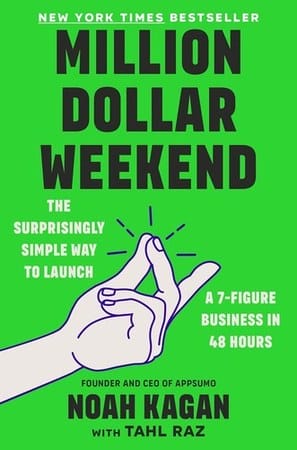
Start a business in 48 hours.
Million Dollar Weekend is the process I used for eight businesses, written down. #1 on Amazon and Audible.
Read the first chapter free
6 responses to “Tyson Cole grew Uchi’s sales 60 months in a row”
Hi Noah,
I’m looking for a PDF/resource you previously made public, but I can’t seem to find the link anywhere on your site.
Could you share the link or point me in the right direction? I’d really love to read it.
Thanks!
Great information and it will very helpful for me and i believe lots of people will get information. keep sharing this type of article, thanks for sharing!!!
nice
Just signing up to the podcast now. Very interested in learning more strategies from you Noah after listening to you on The Smart Passive Income Podcast with Pat Flynn. This sounds like an awesome one to start with & then back to Episode 01…
Hope you got some free sushi out of that one (at least someone got some value), first time ever I had to turn off your podcast.
Hi, Allana! Thanks for the note. I’m part of the team that helps out with the podcast.
What DIDN’T you like about this podcast? What was your favorite podcast we’ve done so far?
Curious to hear. Also, we have 3 more podcasts coming in the next 6-8 weeks, so curious what you think of those when they’re released.