To start a business with no money, get paid before you spend a cent: no LLC, no logo, no website until you’ve made your first dollar. Pick a problem you can solve by hand, ask people you know to pay for it, collect through a free payment link, and deliver manually. Your customers fund the business. You never have to.
You don’t need money to start a business. You need a customer.
I’ve heard “I’d start something if I had the money” from more people than I can count. It’s the most comfortable excuse in the world because it sounds responsible. It isn’t. It’s a way to never find out whether anyone wants what you’d make.
Want the one email I send when I have something worth sending?
114,000+ entrepreneurs get it. One story from my business, one tactic you can use. No schedule, no fluff.
Here’s how to find out this week, for free.
Playing business vs. running one
There are two kinds of “starting a business.” Only one of them is real.
Playing business looks like: registering an LLC, buying a domain, designing a logo, building a website, printing cards, picking a company name for three weeks, making a pitch deck, ordering inventory, and calling yourself CEO. It feels like progress. It costs money. And you can do all of it without a single person ever paying you.
Running a business looks like: someone paid you for something.
That’s it. That’s the line. No LLC, no logo, no website until you’ve made $1. Stop playing business.
Every dollar you spend before your first sale is a bet on an idea nobody has validated. Every dollar you spend after your first sale is an investment in something that works. Same dollar, completely different risk. So get the sale first. The nice-to-haves can come out of the profits.
I actually don’t start businesses until I know they’re already working. That’s the whole trick. Sell it, then build it.
Do the service first
Whatever you want to build, do it by hand first.
If you want to start a SaaS business, do the service before you make the software, then create software to do that service. Want to sell a course? Coach three people live. Want to launch a meal delivery app? Cook for five neighbors and deliver it yourself. Want an agency? Do the work for one client personally.
Manual first does three things for someone with no money:
- It costs nothing. Your time is the only input, and you have that.
- It gets you paid this week. Software takes months. A Google Doc takes an hour.
- It teaches you what to build. You will learn more from delivering three orders by hand than from a year of planning. The product you build afterward will be the one customers actually asked for.
The engineering disease says “I’ll build it, then sell it.” Flip it. Sell it, deliver it manually, build it later, if ever. Plenty of businesses never need the software.
The zero-dollar stack
1
A phone
Call, text, DM.
Not email. Email is
where asks go to hide.
Cost: $0
2
A payment link
Stripe, PayPal, Venmo,
Cash App, Gumroad.
Ten minutes to set up.
This is your checkout.
Cost: $0
3
A Google Doc
Sales page, order form,
product, contract and
invoice. One doc.
Share the link.
Cost: $0Bought later, with customer moneyDomain. Logo. Real website. LLC. Business cards. Inventory beyond what is already paid for.No LLC, no logo, no website until you have made your first $1.
Here’s everything you need to run a business this weekend. Total cost: $0.
- A phone. For calling, texting, and DMing customers. Not email. Email is where asks go to hide.
- A payment link. Stripe, PayPal, Venmo, Cash App, Gumroad, Square. Free to set up, takes ten minutes, and it’s your entire checkout.
- A Google Doc. Your sales page, your order form, your product, your contract, your invoice. One doc can be all of these. Share the link.
That’s the stack. If you want to get fancy, add a free Carrd page or a Notion page with a Buy button. But honestly, I’ve seen people close thousands of dollars with a text message and a Venmo handle.
Everything else (a domain, a logo, a real site, an LLC) is a purchase you make after customers have handed you the money to make it.
Pre-sell everything
Pre-selling is how you fund a business with zero capital. You collect the money first, then use it to make the thing.
It works for services (obviously). It works for courses (sell ten seats, then record). It works for physical products (take orders, then buy exactly that much inventory). It works for events, memberships, software, consulting, anything.
I’ve done this myself. A few years back I let my Monthly1K students pick a business for me to start in 24 hours, with no help from the AppSumo list. They chose beef jerky. That night I ran the numbers and realized that at $20 a bag with $5 of profit I’d need 200 one-off buyers to clear $1,000, so I sold subscriptions and office orders instead. The pitch was a 2 a.m. email: monthly jerky service, $40 a month, about $1.42 a day, blocks of three months ($120) or six ($240), limiting it to 20-ish people, PayPal me. Health-conscious friends said yes, offices said yes (one took a twelve-month package), and the service providers I was already paying said yes. I ended the day at $4,040 in revenue and $1,135 in profit and only then went and found the jerky, through Google and Instagram. The customers funded the inventory. My bank account never got involved.
The one thing I did spend was $7.99 on a domain the night before, and I still regret it, because it did nothing. Every sale came through PayPal and a text message.
How to pre-sell in a weekend:
- Write the offer in one sentence. “I’m doing [thing] for [people]. $[price]. Delivered by [date].”
- Set up the payment link. Ten minutes.
- List ten people you know who have the problem. Contacts, communities you’re in, anyone who’s paid you before.
- Send the ask to all ten. Phone or DM. Include the price. End with a yes-or-no question.
- Send the payment link the second anyone says yes. Yes decays. Collect while it’s warm.
- Ask every no for a referral. “Who do you know that deals with this?”
- Deliver by hand, over-deliver, ask each customer for two more names.
- Three paid? Keep going. Zero paid after ten asks? Change the idea. Full method in how to validate a business idea in 48 hours.
Everyone’s interested until they have to pay. Pre-selling finds out who’s actually interested, and it does it with their money instead of yours.
Use other people’s audiences and marketplaces
No money means no ad budget. Fine. You don’t need one. Other people have already spent millions building crowds of buyers. Go stand in front of their crowd.
Marketplaces. Etsy, Amazon, eBay, Fiverr, Upwork, Gumroad, Facebook Marketplace, Craigslist, the App Store. Buyers are already there with their wallets open. List your thing. Zero traffic cost.
Communities. Every Facebook group, Discord, Slack, subreddit, or forum where your customers hang out. Be useful for a week, then post your offer. Free.
Partners. Find someone who already talks to your customers (a newsletter, a podcast, a local shop, a bigger business in an adjacent lane). Ask yourself what’s in it for them, then offer that. A cut of sales, free product for their audience, content they don’t have to write. People don’t owe you anything, so you create a no-risk win for them.
Your own list, from day one. Every customer, every “maybe,” every dollar-challenge investor goes in a spreadsheet. Software features can be copied in an afternoon now. Your list can’t. The asset is the email list, and you start it with the first name.
If you don’t have money, creativity is your friend. Every one of these is a creative substitute for capital.
The Freedom Number
Here’s how you know when your side thing has become a business.
Your Freedom Number is the monthly income that would let you cover your life without your job. Not “rich.” Free. Rent, food, insurance, the basics, plus a little.
Write it down. Mine was $3,000 a month from age eighteen until I turned thirty. A friend’s was $1,500. If you’re keeping the day job, $500 a month on the side is a perfectly good number. Pick one that doesn’t scare you.
Then do the math backward. If your thing sells for $500, and your Freedom Number is $5,000, you need ten customers a month. Ten. Not ten thousand. Can you picture ten people paying you $500 next month? Do they exist? Can you reach them?
That’s the same math as the One-Minute Business Model (revenue minus cost is profit, then divide the target by the profit per sale), and it’s the single most useful thing you can do for an idea before you commit to it. It turns “I want to start a business” into “I need ten customers,” and ten customers is something you can actually go get this month.
Until you hit your Freedom Number, it’s a side project. Keep the day job, keep asking, keep delivering. When you hit it three months running, it’s a business, and you get to decide what to do next.
A real example
A reader named Hanny Tran documented her first weekend on Medium. Zero budget. She asked seven people she knew to pay for an idea she’d had that morning, got four rejections, and closed three paying customers by Sunday. No website. No company. A message and a payment link. Then she decided the idea wasn’t a fit for her skills and dropped it to look for a better one, having spent nothing but a weekend. (cheershanny.medium.com/million-dollar-weekend-how-noah-kagan-made-me-rich-er-and-brave-r-20cfe770f0d1)
That’s what starting with no money looks like. It looks like asking.
Mine looked similar. AppSumo started as a single deal. In 2010 I cold-emailed the founder of Imgur, a college student I’d never met, and said I love your product, we’re launching a deal site, I think we can sell 200+ copies of Imgur Pro for you at no cost or work on your end. Then I emailed Reddit’s founding engineer, took him to breakfast, and asked for free ad placement. They said yes because I asked. The “site” was one web page with a PayPal button: 48 hours and $50 to build, most of that a $12-an-hour developer for four hours. The first sale landed within minutes, and I sold the 200 licenses I’d set as the goal. The logo came later. The website that didn’t embarrass me came much later.
Watch it
The full jerky story: the budget, the exact emails, the office-manager trick, and the $7.99 domain I wish I hadn’t bought.
Jump to the exact email I sent, at 1:36.
The excuses, and the reply to each
I’ve heard them all. Here’s what I say back.
“I don’t have money to start.”
You don’t need any. Sell first. The customer funds the business. See everything above.
“I need a website first.”
No, you need a customer first. A Google Doc and a payment link are a website. Buy the real one with your profits.
“I need to form an LLC before I take money.”
Take the money. You can register the business the moment it’s clearly real, which is after the third customer, not before the first.
“I don’t have an idea.”
You have twenty. What did you pay for this month, what annoyed you, what did you Google, what do friends ask you for? Full list in business ideas you can start this weekend.
“I don’t have an audience.”
Nobody does at the start. You have a phone with contacts in it. That’s your Zone of Influence and it’s more than enough for the first three customers. Then use marketplaces and other people’s audiences. How to get your first customer.
“I don’t have time.”
This takes a weekend. Ten messages. You have time. What you might not have is willingness to be told no, which is a different problem, and it’s fixable: go do the Dollar Challenge.
“What if someone steals my idea?”
All business is a copy of a business. Every business has been done. Nobody is going to steal an idea you haven’t validated, and once you’ve validated it, execution is the thing that matters, and they don’t have your customers.
“I need to learn more first.”
People confuse inaction with patience. Reading another book is not starting. Ask one person for money today and you’ll learn more than the book would teach you.
“I’ll start when the idea is perfect.”
Every idea is wrong at first. The only way to make it right is to put it in front of a paying customer and listen to what they say. Fail quick, iterate fast.
Notice none of the replies involve spending money. Every excuse on the list is really about fear, and fear is free to fix.
Where the money actually goes (once you have it)
Once you’re making money, here’s where I’d spend it, in order:
- Delivering better for current customers. Tools, help, whatever makes the thing you already sell work better. Do more of what makes you grow.
- Reaching more of the same customers. The channel that got you the first three, done bigger.
- The stuff that makes it look like a business. Domain, site, LLC, logo. Now they’re investments, not gambles.
And when it starts working, resist the itch to start something new. If you found something that works, there’s so much more meat on the bone than you realize. Run up the score.
FAQ
Can you really start a business with no money at all?
Yes. Sell a service or pre-sell a product to people you already know, collect payment through a free link, and deliver by hand. The customer’s money funds everything after that. You don’t need an LLC, a website, or inventory until someone has already paid you.
What is the cheapest business to start?
A service you can do yourself, sold to your own network. Résumé rewrites, bookkeeping cleanup, meal prep, dog walking, a live workshop, consulting in whatever you already do at work. Zero inventory, zero software, zero ads. Ten text messages with a price, then deliver.
Do I need an LLC before I make my first sale?
No. Get the first three paying customers, then register the business once you know it’s real. Forming an entity before anyone has paid is playing business: it costs money and proves nothing. Handle the paperwork when the revenue justifies it.
Get the first chapter of Million Dollar Weekend free
Chapter 1 is the Dollar Challenge, NOW Not How, and your Freedom Number. The no-money launch and the preselling playbook are Chapter 5.
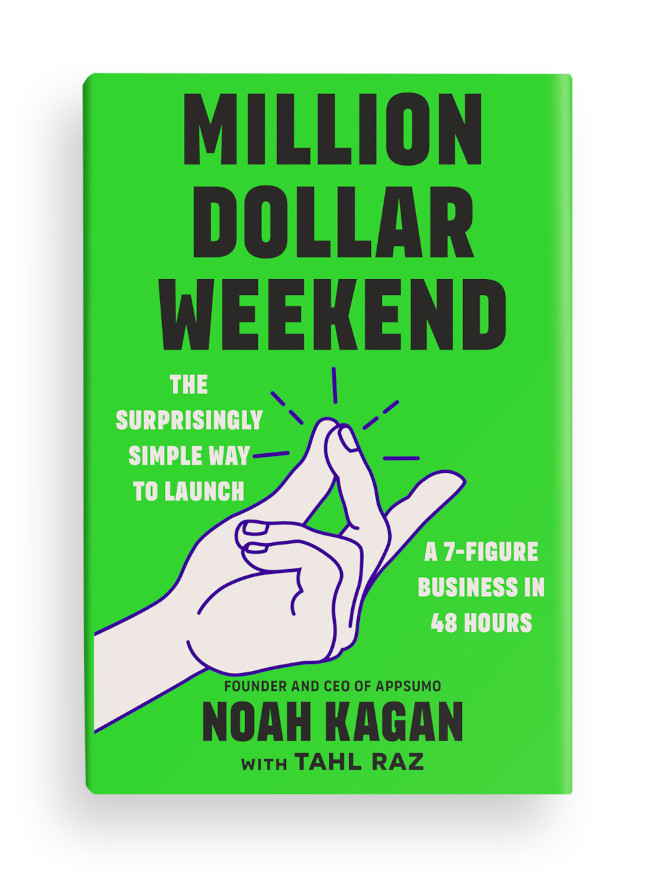
Or grab the whole thing: Million Dollar Weekend
Set up a payment link. Text ten people the price. Do it today.
Start a business in 48 hours.
Million Dollar Weekend is the process I used for eight businesses, written down. #1 on Amazon and Audible.
Read the first chapter free
2 responses to “How to Start a Business With No Money (Get Paid Before You Spend)”
Is it possible to sell “Positive Motivation Quotes?” I am serious about this question
We are looking to hearing from you soon and you are really interesting .